Last updated
28 March 2025
Did You Know?
England Athletics National Volunteer Awards
- 23 January 2021
We have been voted 'Club of the
Year' in the England Athletics National Volunteer
Awards, 23 January 2020
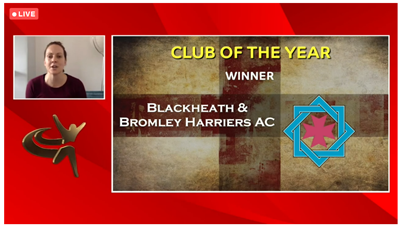
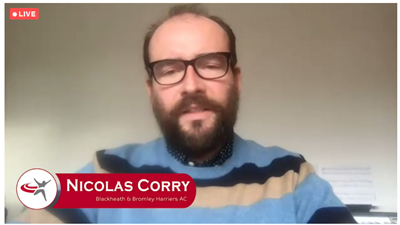
Club of the Year award: Recognising
both the achievements of a club, as well as
demonstrating ongoing commitment and passion through
the opportunities they have given to everyone
involved in the club over the last 12 months.
England Athletics
23-01-21

VP Mark Purser selected for
International Starter’s Panel
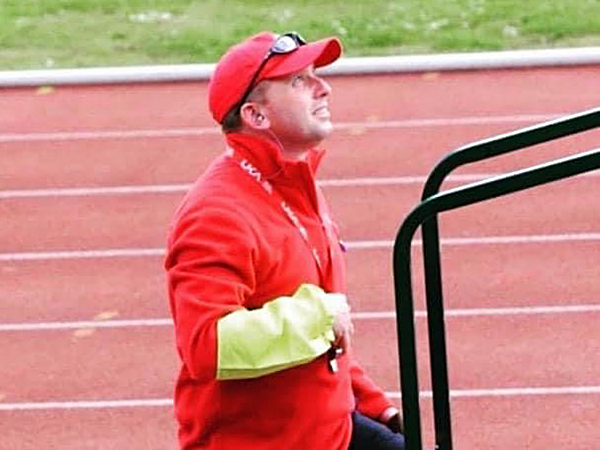
The next time you switch on the TV to watch an
international athletics event you might see this familiar face. Our very own
Head of Summer Athletics and Starter, VP Mark Purser has been selected for
the International Starter Panel after passing his European starter course.
His first scheduled international event will be the European Indoor Champs
in Poland in March 2020 (let’s hope it happens). Well done Mark!!
England Athletics
Regional Volunteer Awards - 19 November 2020
It was a
successful evening for Blackheath & Bromley Harriers AC at the England
Athletics London Region awards ceremony last night. The Club were winners in
two categories, and also achieved several runners up places.
BBHAC were
awarded “Club of the Year”, testament to the collective hard work and
achievements of so many in the Club. In addition, Claire Austridge was named
Volunteer of the Year, recognising the time and effort she freely gives to
fundraising, our young athletes and the wider community.
Holly Platt,
who produced an excellent video to accompany the Club’s nomination for Club
of the Year award, was runner up in the “Young Volunteer of the Year”
category for her outstanding contribution to the Club's social media
presence.
David Liston,
who has spent many years coaching the Club's middle distance athletes,
achieved runner up in the Coach of the Year category. David spoke genuinely
of the fulfilment coaching has given him over the years.
Finally, John
Baldwin, who in over 65 years of membership has undertaken many vital roles
within the club, was named runner up in the Services to Athletics category.
President Nic
Corry had this to say in response to a great evening for the club:
"These
awards recognise the collective efforts of the entire Blackheath &
Bromley Harrier Community. BBHAC achieved success in a wide range of
categories demonstrating that, even in a challenging year for the Sport
of Athletics, BBHAC continues to excel as a Club. The volunteers, who
freely give their time, allow us to have the platform to enable so many
to succeed. We should all celebrate in this night of achievement for the
Club and its volunteers!"
Read the
official write up:
Winners and runners-up for Regional Volunteer Awards for London
On this day the
6th May 1954
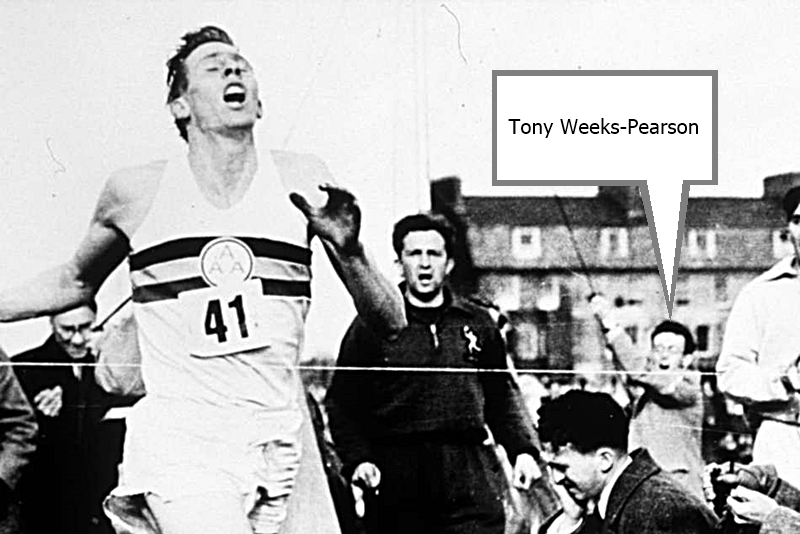
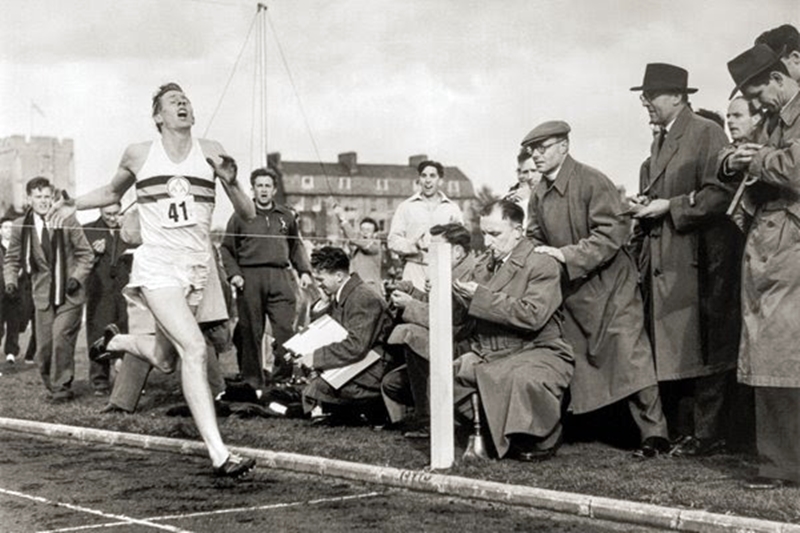
66 years ago on this day, Roger Bannister became the
first man to run a mile in under 4 minutes. A mark that had once been
considered physically impossible. This was a great occasion at the Oxford
track that had been planned for some time with the three quarter mile record
having been broken along the way. Worries about the weather nearly stopped
the effort but off they went and Brasher and Chataway did their jobs to
perfection up to the three quarter mile mark and then it was Bannister on
his own. Pushing himself like never before he was in a state of near
collapse as he broke the tape. The official announcement from the
loudspeaker was eagerly awaited and when it came, it was frustrating as they
listed the whole raft of records that Roger had broken then it was “....in a
time of, 3 minutes....”. The rest of the announcement was lost or drowned by
the cheering crowd. 3000 there that night and Brasher reckons he’s met “all
twenty thousand of them”. The famous photo of Roger crossing the line has PP
Tony Weeks-Pearson in it holding the end of a rope.
Ian Wilson comments: "I remember Tony W-P
telling me that it was one of the supporting cables holding up a pole
which carried the PA cable across the track. The wind was so strong
that it pulled one of the cables out of the ground and Tony had to hold
it up so that the track was clear for the race."
The record lasted until 21st June when Australian John
Landy, helped by Chataway ran 3.57.9 which was rounded up to 3.58.0. This
lasted until Derek Ibbotson ran 3.57.2 at the White City in 1957 which my
Dad witnessed during his break from work at nearby Park Royal. A few years
ago I acquired the brilliant 60 page programme for this meeting that had
been signed by Chris Brasher. It also had the race result written in it.
16 years ago on this day, there was a 50th anniversary
celebratory meeting at the same Oxford Track. There were 3000 tickets and I
was lucky to get one. Les Roberts, Pat Calnan and I left Orpington in my car
and twenty minutes later we were back in Orpington as one of them had
forgotten to bring his ticket. No matter, we had plenty of time and met up
with the likes of Mel Batty, John and Margaret Baldwin and Julian Goater in
a pub close to the Track. An excellent meeting and everyone was there. Sir
Roger, John Landy, Derek Ibbotson, many other Olympians including John
Bicourt. An amazing programme had been put together with many photographs
that I’d never seen before. Smartly dressed Stewards in Bowler Hats handed
these out and there was no charge. I’d have willingly paid £20. Met Julian
Goater a few years later and he bemoaned the fact that the Oxford Uni
Athletics Club hadn’t been able to make money out of the event. That was Sir
Roger’s decision. I managed to have a few words with him and get him to sign
my programme. Auctioned that at a function to raise money for Blackheath
Young Athletes. It made £130. The main event was a mile won by Australian
Craig Mottram in 3.56.31. With him at the bell and dropping over 3.5 secs on
the last lap was 20 year old Mo Farah. He finished in exactly 4 minutes. A
great event and a great day out.
66 years since a great day in History.
Mike Martineau 6 May 2020
Jackie Mekler
1932-2019
Just had it confirmed that Jackie Mekler sadly died
yesterday (1 July 2019). He joined Blackheath Harriers on 6 February 1954
and was a life member…
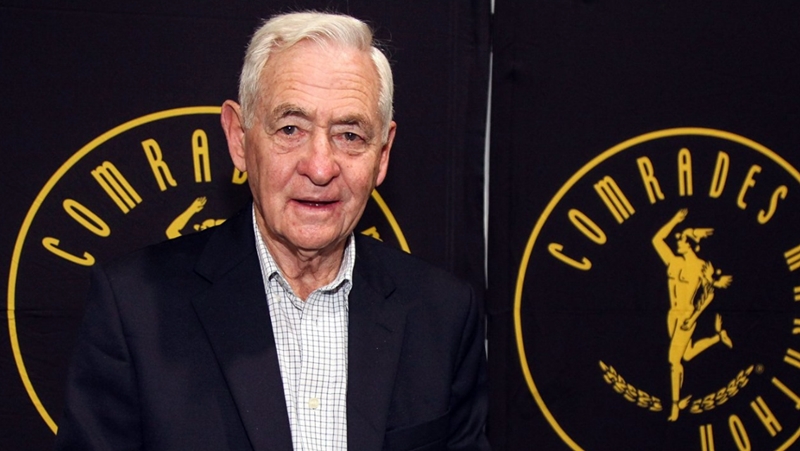
The oldest surviving Comrades Marathon winner has
passed away at the age of 87. Jackie Mekler was not just a runner and a
winner, he was the last of the Comrades Great 5-time Winners who completed
The Ultimate Human Race 12 times.
Jackie ran his first Comrades Marathon in 1952
finishing in 7th position. He won his first Comrades Marathon in 1958 and
went on to claim further victories in 1960, 1963, 1964 and 1968. He holds 10
Comrades Gold medals, 1 Silver and 1 Bronze.
From the age of 9, Jackie grew up in the Arcadia
Orphanage in Parktown, and it was at the age of 13, that he started sneaking
out in the early mornings to go for a run. He found freedom in this and
spent this time dreaming of becoming a famous athlete.
He was expelled from the orphanage in his teenage
years and went to stay with his father in a boarding house. He managed to
secure a job at a printing company as an apprentice printer.
Jackie joined the Germiston Callies Harriers at the
age of 16 and was running marathons by the time he was 18. His love for the
Comrades Marathon started at the age of 20 when he entered his first
Comrades race.
Following his first two runs, Jackie took a break from
the Comrades in order to pursue the standard marathon and to represent South
African on numerous occasions in international competition during which time
he held the world 50 mile record and earned a silver medal at the
Commonwealth Games.
Returning in 1958 for the Up Run, Jackie completed the
course in 6:26, a full 45 minutes ahead of second place. Over the next
decade, he would go on to win the race a further 4 times.
1960 would be the year that would cement Jackie in our
history books forever, as it was the year he became the first runner to
break the 6-hour barrier on the Up Run, something that had taken 4 decades
to achieve. His time of 5:56 was not his fastest though, with his best time
of 5:51 again winning the race in 1963.
Of Jackie’s 12 runs, 11 placed him in the top 10 and 9
of those placed in the top 3, a phenomenal achievement.
He joined Blackheath Harriers in 1954. Not all his
achievements were in SA - he also ran and won the London to Brighton in
1960. I was in communication with him a few years back and found him to be
most generous and kind.
Peter Rogers
Jackie Mekler’s marathons feature in the Blackheath &
Bromley top 1000 performances and he is ranked 23rd on our all-time list.
His Commonwealth silver medal was in the 1954 Vancouver games and reports of
his run in the Polytechnic Marathon in 1955 and a month later in Reading can
be found in the Blackheath Harriers Gazette of that year.
Chris Haines
|
02:35:25 |
Jackie Mekler |
Johannesburg, South Africa |
1 |
17-Apr-54 |
|
02:40:57 |
Jackie Mekler |
Vancouver, Canada |
2 |
07-Aug-54 |
|
02:40:21 |
Jackie Mekler |
Windsor-Chiswick |
12 |
18-Jun-55 |
|
02:50:49 |
Jackie Mekler |
Reading |
3 |
23-Jul-55 |
|
02:33:06 |
Jackie Mekler |
Queenstown, South Africa |
1 |
20-Apr-57 |
|
02:36:04 |
Jackie Mekler |
Athens, Greece |
5 |
06-Oct-57 |
|
02:39:45 |
Jackie Mekler |
Krugersdorp, South Africa |
1 |
02-Mar-63 |
|
02:30:45 |
Jackie Mekler |
Bloemfontein, South Africa |
2 |
05-Apr-63 |
|
02:27:53 |
Jackie Mekler |
Port Elizabeth, South Africa |
2 |
28-Mar-64 |
Ron Pickering Memorial
Fund 2017
 From
England Athletics website at https://www.englandathletics.org/england-athletics-news/volunteers-recognised-at-2017-england-athletics-hall-of-fame
From
England Athletics website at https://www.englandathletics.org/england-athletics-news/volunteers-recognised-at-2017-england-athletics-hall-of-fame
A coach and well-loved BBC commentator, Ron Pickering
passed away in 1991 and since then the fund set up by his family the has
raised and awarded over £1.5 million in small but very significant grants to
over 2000 young British athletes, to help fulfil their potential.
Three Ron Pickering
Memorial Fund 2017 Athletes of the Year are recognised:
- U23 Athlete of the Year: Reece Prescod
- U20 Athlete of the Year: Maya Bruney
- U18 Athlete of the Year: Alastair Chalmers
Reece said that his form and wins had been seen as a
breakthrough but he knew it was going to happen. Of his British Champs win
and World Athletics races, "It was great being in front of a British crowd."
Maya said, "Getting gold really gives me a boost as I
enter the Senior Age Group. U23 is going to be tough but it's a real
positive to see new athletes coming through."
Alistair said the additional funding has given him a
real boost and would be really helpful for the additional travel and
accommodation costs living in Guernsey ensues."
Alan Brent 1918 - 2017
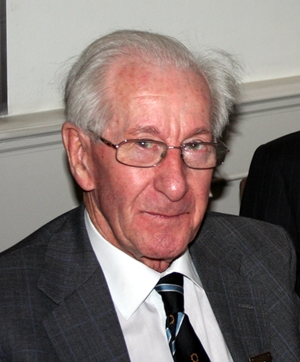 Alan
Brent 18/11/1918 to 1/6/2017
Alan
Brent 18/11/1918 to 1/6/2017
When Sydney Wooderson was alive it was very fair to say that he was the
‘Greatest living ‘Heathen’. When Sydney died at the end of 2006 that title
quite rightfully passed to Alan Brent.
Alan joined Blackheath Harriers on 4th March 1946 at the
age of 27. He has died at age 98 after 71 years of extremely distinguished
service to his Club and to Athletics. His wife, Brenda, had died at age 96
less than 4 months previously. Her support of Alan and her service to the
Club had also been legendary.
Alan joined as an Athlete shortly after the War so it is probably best to
start by giving a brief summary of his career as a runner. He ran in the
Blackheath team in 20 consecutive Southern Cross Country Championships and
in 20 consecutive National Cross Country Championships (1946/7 to 1965/6, so
47 years of age on his last appearances). He was in the scoring 6 on 18
occasions in the National and 16 times in the Southern. Just 3 team medals
though, bronze in the 1948 National (the race being won by Sydney Wooderson)
and silver and bronze in the 1948 and 1950 Southerns. His best National saw
him finish in 32nd place and he managed 15th in the Southern. His first Club
win was in the 1946 ‘Closing 5’ where a far too generous allowance of 5
minutes was given to him. Newcomer having it over on the handicapper! It has
ever been thus! He ran regularly for Kent in the Inter Counties and did very
well on the Road in events like the News of the World London to Brighton
which became the National 12 stage. He had been known to win Club events by
5 minutes and famously in the Club ‘B’ team with Braughton and Scotting
“gleefully defeated” the ‘A’ team Club road specialists in the 1952 Mitcham
15. He later made his mark with other “geriatrics” in the Sunday Times Fun
Runs. ‘Fun’ seeming a misnomer as the Club History records that these events
were fiercely competitive.
The Club History records that what was “more impressive than his consistent
running was his continued industry for the Club”. He created “an impression
of integrity, understanding and dedication not readily matched”. He was Club
President in 1966/7 leading an administration including Tony Hayday, Geoff
Last, Bob Taylor, Alan Ball, Brian Stone, Bob Richardson, Norman Page, Jim
Day and Peter Baigent. Alan was for 5 years the Club’s Cross Country
Captain. For 11 years he did penance for his win in the 1946 Closing 5 by
being George Brooks’ Assistant Handicapper.
He was President of the South of Thames Cross Country
Association in 1966. Also President of the Southern Counties Cross Country
Association, Kent County Athletics in 1979, and the English Cross Country
Union or ECCU (now ECCA) in 1989. He was presented with the Queens Jubilee
Medal in 1977 and was recognized by Bromley Sports Council with an award in
1989 recognising his service to Sport in the Borough. More recently he won a
prestigious London Sports award for his outstanding contribution to
Athletics over so many years.
He reckoned he had been to 50 consecutive Nationals and it was ironic that
the first two he missed were in 1994 and 1995 when the Club won the team
title. He also missed seeing the under 17s win the team title in Havant in
1997.
He attended every day of Athletics at the 1948 London Olympics and could
point out on photos exactly where he and Brenda sat. He was asked once to
point out Jack Braughton in the 1948 Olympic Men’s Athletics team photo.
“Jack wasn’t in the photo”, he said, “he couldn’t get time off from work”.
He served with Jack on the Board for Norman Park Track Management until they
were both in their 90s and Alan was a regular at Club Track events where he
took responsibility for all the field equipment. Meanwhile, wife Brenda
worked in the Track café with Anne Cilia’s Mum, Vi Stenning, and Ken
Johnson’s wife Hilary serving tea and wonderful cake baked by Brenda. You
felt quite deprived if you found that they had sold out and you hadn’t had a
piece.
Club committee meetings with Alan in attendance were quite a lesson. He was
never rattled and never lost his rag. His contributions were always
measured, thoughtful and intelligent. A great man with great knowledge and
great judgement.
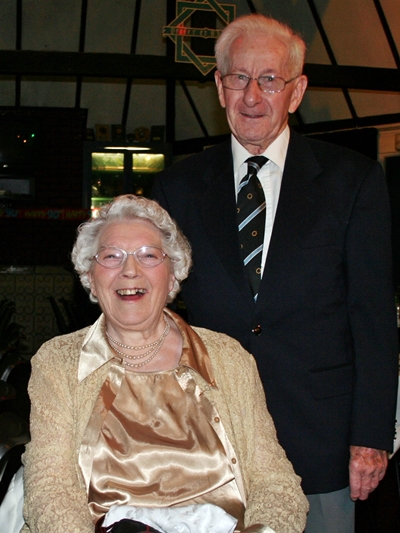 20
or so years ago, Club Dinners were more frequent and he and Brenda sat with
others of their age group. Brenda ran the raffles bringing her ‘old bag’
which was eventually replaced by a ‘new old bag’. At one of these dinners he
was ambushed so we could properly celebrate his 80th birthday. Peter Lovell
provided some fine artwork and Alan, giving an impromptu speech, gave
younger members the benefit of his advice: “retire early and hammer the
pension fund”! His 90th was a very special Club occasion with a full house
greatly enjoying some fabulous tributes to a very special man. Brenda also
made it upstairs for the first time in years. The ECCA President was there
and Alan was showered with gifts and praise. Mike Peel took a brilliant
photo of Alan and Brenda, printed it, framed it and presented it to them
that very same evening. It was a proud possession in their home.
20
or so years ago, Club Dinners were more frequent and he and Brenda sat with
others of their age group. Brenda ran the raffles bringing her ‘old bag’
which was eventually replaced by a ‘new old bag’. At one of these dinners he
was ambushed so we could properly celebrate his 80th birthday. Peter Lovell
provided some fine artwork and Alan, giving an impromptu speech, gave
younger members the benefit of his advice: “retire early and hammer the
pension fund”! His 90th was a very special Club occasion with a full house
greatly enjoying some fabulous tributes to a very special man. Brenda also
made it upstairs for the first time in years. The ECCA President was there
and Alan was showered with gifts and praise. Mike Peel took a brilliant
photo of Alan and Brenda, printed it, framed it and presented it to them
that very same evening. It was a proud possession in their home.
As they both became housebound they were delighted to receive visits from
Club members and these were always happy occasions. The owner of the garage
around the corner from whom they bought all their cars visited one day
bringing lots of photos. He had been one of Alan’s pupils and had been away
on a School trip abroad with both Alan and Brenda. When Graham Botley made
his farewell tour, one of his demands was to be taken to visit Alan and
Brenda. Another very special and happy occasion. On one occasion Alan was
asked whether he would be going to the Club photo shoot. He hadn’t realized
it was taking place. Denis Lawrie and Steve Hollingdale did the honours so
Alan featured in the 2012 Club photo.
When he could no longer run, he swam. Often with PP Vic Beardon. Just a
couple of days after his 80th, Alan celebrated by competing in the Maryon
Wilson swimming race. The Blackheath Harriers Social Club was formed in 1973
and this was chaired by Brenda. Ladies competed in their table tennis team
using the Blackheath Harriers name. With barn dances, raffles, jumble sales
and tombolas the Social Club, including the likes of Maggie Haines, raised
an awful lot of money that enabled much needed work to be done in the
Clubhouse and at the Track. Brenda’s reward was being made an Honorary Life
Member and later a Vice President.
They both gave great encouragement to Youth and the Club History records
that “many can testify to their encouragement of youth, not only officially
or on coaching courses, but morally and always cheerfully”. He was a very
special man, they were a very special couple. Not sure we will ever see the
likes of them again.
Mike Martineau, 13 June 2017
Hanna Cordell 1946-2017
As submitted to Athletics Weekly by Nick Brooks 10 May
2017 (Hanna died on 29 April 2017)
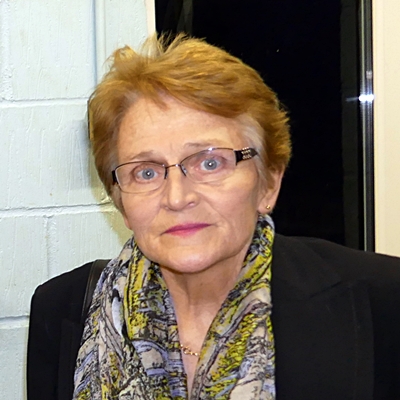 It
is with much regret that I have to report that the very popular Hanna
Cordell has passed away recently after battling illness, having given her
life for and so much to the sport of athletics.
It
is with much regret that I have to report that the very popular Hanna
Cordell has passed away recently after battling illness, having given her
life for and so much to the sport of athletics.
Hanna was the club secretary for Blackheath & Bromley
Harriers AC for many years and has also been a team manager for the many
BBHAC track and field teams, a regular timekeeper and a track judge, and
brought her strong organisational skills with her every time to the events
she would attend. Prior to that Hanna had held a series of management
positions with Bromley Ladies. With husband Dave to who she was married to
for 49 years, Hanna met many new friends from the world of travelling
officials who went on to become good friends from many different clubs.
Hanna (nee Grundlehner) was born in Arbon in Switzerland
in April 1946 and met Dave when she was a student staying in London with
Dave’s parents, never returning home in the 1970s. Although not a serious
athlete herself, Hanna did run events like the 7 Sisters, and 10km and half
marathons, but her true love was officiating in the many capacities whether
it be track and field, cross country or road events. Always up early on
competition day, Hanna would accompany Dave to wherever they were going to
be ready to pitch the club tent in a favourable location to provide much
needed shelter and a base for the club athletes who would turn up later in
the day.
Living close to BBHAC in the Bromley, Kent, area for the
past 20 years, Hanna leaves behind her husband Dave, two children Alice and
Tom and two grandchildren Shannon and Joe. Hanna will be a tough act to
follow as Club Secretary and also Trophy Secretary as the club has many
trophies which have all been photographed and catalogued by Hanna. More
importantly it is known that Hanna made tea in bed for Dave everyday of
their married life, not sure what happens now !
Hanna never expected thanks or praise for her efforts and
was always seen at the club events throughout the year, quietly going about
her job. Hanna’s life was devoted to our much loved sport and is a great
loss to her family, her friends, BBHAC and the sport of athletics.
Britain’s Got Talent & B&BHAC
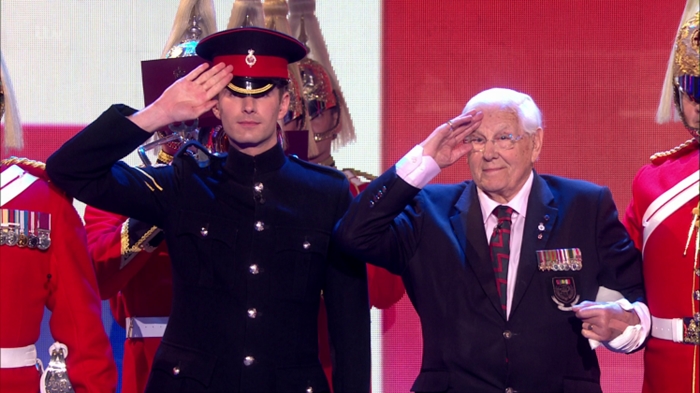
2016 Britain’s Got Talent winner Richard Jones introduced
97-year-old war veteran Fergus Anckorn
to the BGT audience after creating a magic trick around his life story.
Fergus joined Blackheath in 1954, these days he lives in Hassocks. Lots of
National coverage This is from the
METRO
29-05-16
Adam Gemili: Lessons learnt at London
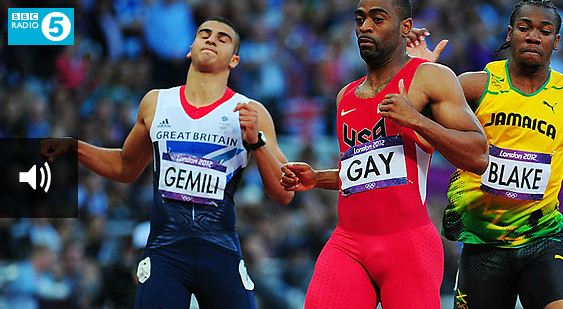 |
If you missed Adam's BBC
Live5's interview on Wednesday night you can listen to it
here...
What a great insight
Adam Gemili: Lessons
learnt at London 2012Sprinter Adam
Gemili speaks about his amazing 2012, and what he learnt from his
appearance in the semi-finals of the Olympics 100 metres when he was
just 18. 21-02-13
|
Serita Solomon in I Will Be Next
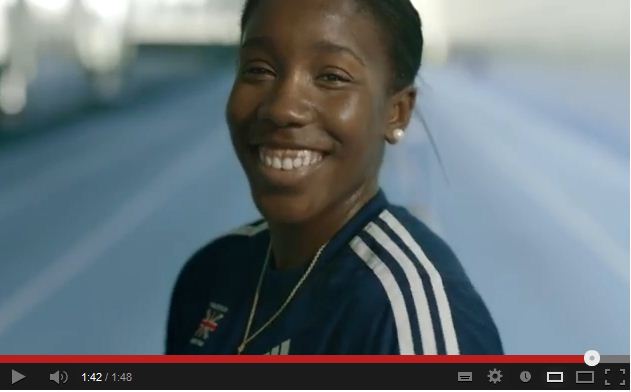 |
Our Serita Solomon is one of the athletes
featured in SportsAid’s new film, called I Will Be Next.
See http://youtu.be/VHlrkW8txZI to watch her in action.
I Will Be Next features ten
young SportsAid athletes who aspire to be our Olympic and Paralympic
champions of the future.
13-02-13
|
Mike
Peel & the Olympic Torch
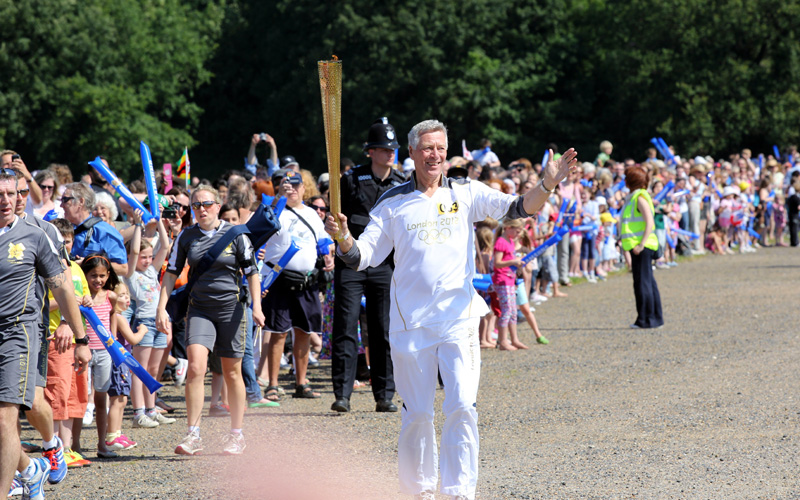
The Olympic Torch came to Bromley on
Monday 23 July 2012 and PP Mike Peel carried it through Crystal Palace Park.
23-07-12
Fergus Ankorn
The Daily Mail has an article
here... 9 February 2012
10-02-12
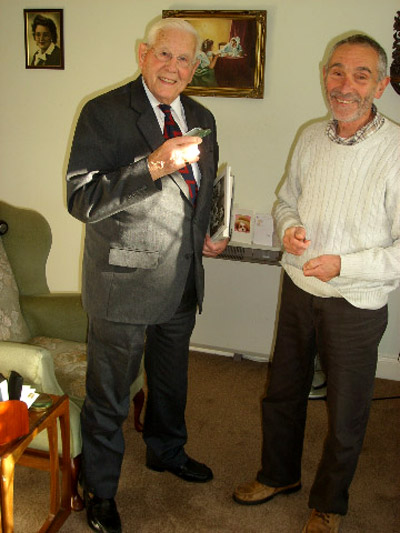
Above is a photograph showing presentation of 50
Year Award to 93 year old Fergus Ankorn, albeit seven years late! He
also has a recent biography published, "Captivity, Slavery and Survival
as a Far East PoW". £15.99 from
www.pen-and-sword.co.uk I also presented him with the 2nd
edition Club History and Sydney's "Forgotten Champion".
John Baldwin PP
12 December 2011
SCOTT OVERALL THE NEW BRITISH
MARATHON FIND
By Alastair Aitken....
( Born 9/2/83)
As I write this on October the 18th, 2011, I realise that Blackheath &
Bromley club runner, Scott Overall, who ran 2:10:55 for the marathon in
Berlin, on the 25th of September this year, had run the fastest marathon
time by any UK runner since John Brown did 2:9:31 in the London in 2005. Yet
it was Overall"s first attempt at racing the distance. He ran 47:37 for 10
miles at the BUPA Great South Run on the 24th of October last year, which
must say something about his distance running ability but his titles were-
UK 5000 track Champion in 2009 and "Under 23" AAA"s Champion over that
distance in 2005. I talked to Scott just before he took Blackheath & Bromley
up from 56 to 25 on leg 2 in the National Six stage road relay at Sutton
Park on the 15th of October.
How did it all begin for Scott
" When I was about 14/15 at Orleans Park School in Richmond I did
cross-country and joined an athletics club from there."
"As a junior we used to go to the National junior road
relays at Sutton Park, Birmingham. I ran for Hounslow at the time. We used
to be quite successful at the road relays as juniors." "I was always about
average. One of the top 10 to 15 fastest times of the day but we would be
leading after two legs and Mo Farah handing over last." "We had good runners
as Hounslow the Sam Haughian, Ben Whitby and Mike Simpson. Probably the best
team in he country for a six stage. A lot of strong guys."
That must have been an inspiration for Scott
" I think so. Half the battle was trying to get in the team."
" I was quite successful as a junior" (Here are some
1500 times he was doing as an "Under 20" in BMC races at
Watford-31/7/02-3:49.69; 14/8/72 -3:48:72; 28/8/02-3:49.04--Later on his PB
was 3:41.90-2008 and 3:58.61 indoors for the mile in 2010 in the USA).
" I remained quite successful as a junior at Under 23
level as well. I went to the European Championships (6th in Under 23 Final
or 5000, on 15th of April in Erfurt Germany, in a time of 14:17.6)."
" I got a scholarship to America so I went out there
to Butler University, Indianapolis, for three or four years."
" I think going to America was what helped me
massively."
" I went out there in 2004. In the UK if you got under
14 minutes, that was seen as amazing but when I went to the USA there were
guys over there at University under 14 minute all the time. Over there it is
not seen as anything!"
"I ran 13:38 when I was out there." (At Stanford,
California 30/4/06. - His PB was 13:28.33 in 2008)
" It opened my eyes to what is good rather than what
you thought was good. So much depth."
"The competition is great. You can only be brought
along."
`" I was there 2004-07. I stayed out in the States
another year with my coach ROBERT CHAPMAN and came back 2008/9."
" I still go over for a couple of months at a time to
Flagstaff, Arizona. For the last four years I have gone to Flagstaff and
then come down and raced at Stanord and Mount Sac races then come over
here."
" Up to 4 or 5 weeks at altitude then come down and
you can either race straight away, which we normally do at Mount SAC and
then you have two weeks to Stanford."
"Injuries have prevented me from running on the track
for the last couple of years!"
" At the same time out of something bad came something
good on the road!"
" At the beginning of this year I did not race very
well at Stanfard and Mount Sac and then I did a half marathon a week later,
because I knew there was a lot of prize money."
" I was in shape but not running very well so, I did
that and ran 63:21 not really training for the half marathon (Half marathon
at Indianaplolis on 7th of May) and so that was when I decided to start
looking towards doing a marathon because, I have always run quite well on
the roads and stuff. BERLIN WAS MY FIRST ONE in 2:10:55."
I thought he was good at cross-country and track as
well but his reply did not indicate that, as far as he was concerned.
"Cross-country is not that great but track is O.K but the road I seemed to
like"
(However, he did do a couple of cross-countries early
in 2011 coming 5th in the Cross International San Sebastian and 11th in he
Cross International Juan Muguerza both in Spain in January.)
Now for Berlin and his good time:- " I felt
quite comfortable the whole way really. The first half I felt fine, felt
great. I was running with a French guy. We worked together to half way. He
kind of dropped off at half way."
"The last half of the race I was completely on my own.
I seemed to cope O.K with that. Really the last 5k was probably the hardest.
I was having to work quite hard for the last 5k to remain on pace."
Were there or are there people that have inspired
Scott?
" Not really. Obviously having Mo. I have known him since I was 14 or 15 and
seeing what he has achieved and that can only be an inspiration. I have
known him since he was quite young so, to know he is World Champion is quite
special really."
Alastair
Gordon Hickey
24-02-09
Highlight of the Veterans
Athletics Club Championships at Lee Valley, on 22 February 2009, was a new UK
best in the over 75s shot putt. Gordon Hickey, who in his younger days was one
of Britain’s top high jumpers, produced a throw of 9.89 to improve the previous
record by 14 centimetres.
| Pat Calnan wrote this article some time ago
(2004) for Masters Athletics Looking at
the imposing bulk of British Record holder for the M70’s shot Gordon
Hickey, it seems hard to believe that he was once the Southern Counties
high jump champion, was coached by Sir Arthur Gold and trained with the
Royal Ballet.
The 70 year old, has been competing for Blackheath
& Bromley Harriers AC for 49 years during which he has metamorphosed
from one the country’s top high jumpers to head the age group rankings
for the shot and throws pentathlon.
Highlight of his career as a high jumper was
winning the Southern title. “I must have jumped 6 foot 2 inches over 30
times but then towards the end of my career I cleared 6 foot 3 on a
grass run up.” He does wonder what he would have jumped using a tartan
runway.
Hickey used to travel across London to train at
Parliament Hill under the guidance of Sir Arthur Gold and his assistant
Ron Murray. It was Gold who arranged for a number of jumpers including
Mary Rand to work with the Royal Ballet. “That was tough training”
recalls Hickey “We were doing all the exercises for a couple of hours
and you could hardly walk afterwards”
Specific event training for the high jump was not
a year round cycle. “I did no jump training in the Winter. We’d just
play football and then around March time started to think about
Athletics”.
Perhaps he would have gone higher had he trained
specifically for the event but the other factor militating against his
jumping was his job as a film and tape editor with ITN. Nightshifts
every other weekend and travel could intrude. He recalls an assignment
in Belfast in 1970 where the only thing that didn’t seem to get bombed
was his hotel.
One meeting he enjoyed was at the White City in
1958 two weeks before the Empire Games. “I was ranked 2nd in England,
4th Briton, but couldn’t get in because all the jumpers from around the
Commonwealth were competing. After many protests I was eventually
allowed to compete and was number 31 on the programme. I qualified for
the Final on the Friday night, but then had to go off to work all night
before returning to compete without sleep the next day. I finished in
7th place.”
Despite being one of the top jumpers in the
country he never gained an International. “The only times I competed
abroad was with the Club on tours to Switzerland and Northern Italy”. He
fondly recalls the Italy trip where races were held on the promenade.
The shot took place on the beach and then they went up to the town
square for the jumps and somewhat surprisingly the discus.”
Hickey had always putt the shot in Club matches
but in his 40’s as his spring deserted him he began to take the event
more seriously. “I cleared 1.81 as an over 40, 1.75 as an over 45 and
1.70 as an over 50 but then my hips just went”
One of his last high jump competitions saw him
return to the straddle as just as the jumpers were about to start the
event at Charlton Park a lorry pulled up and took the mat off to another
higher League Division match at Sutcliffe Park. They were left to land
in the sand, an opportunity turned down by some of the field but
accepted by Hickey with some aplomb as he won the competition .
Hickey won his first National Shot Putt title when
he was an over 50 and has set British Records in all age groups up from
there. “I can’t actually remember how many titles I’ve won. I’ve never
kept records but since turning 40 it’s something like 10 high jump
titles and 14 for the shot.”
He currently does a couple of training sessions a
week but competes very regularly. He can still be seen in action in the
Southern Men’s League either in Division One and Three often beating
athletes who are 50 years younger.
In the 2001 season he also competed in the British
Athletics League Division One. The match at Eton saw the British Over
65’s Record holder going head to head with the USA’s Olympic Silver
Medallist from Sydney 2000 Adam Nelson who was competing for Birchfield.
Nelson won. “The only time I’ve been in a competition where someone has
thrown over twice as far as me” commented Hickey who didn’t enjoy the
experience.
What he is enjoying is the wide variety of throws
competition available. He has set a British record for the throws
decathlon and is a dab hand at the Greek discus which is basically doing
a standing throw with an overweight implement. “If I do a spin in the
Southern League with the 2kg it goes about 25.10. When I do the standing
throw it goes about 25.00 which shows how good my turn is!”
He is bluntly philosophical about his
achievements. “ It’s not a case of how good you are it’s more a matter
of whether you are still alive. You may be the most talented athlete in
the world but it’s no good if you’re pushing up daisies” He added that
the standard of sandwiches at funerals is improving.
Hickey has just returned from the European Masters
in Denmark. He enjoyed the trip with his wife who is Danish but the shot
competition was a disaster. He’d checked with the organisers that they
had large diameter shots but when he got to his competition he found
they were all at the other pool. “I had a lot of problems with the
smaller shots and the wet conditions” He threw 11.28 but did further in
the throws pentathlon with 11.82. “I got home and threw over 13 in
training.” |
|
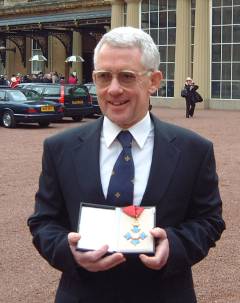
Congratulations
to PP Alan Pickering who received a CBE in the New Year Honours for
services to Occupational Pensions - Alan is Chairman, European
Federation for Retirement Provision.
1-01-04
|
Obituary for John
Herring in 15 October 2003 Daily Telegraph
John Herring, who died on October 7 aged 68, enjoyed a
long association with the London Marathon.
The Marathon"s inaugural running in 1981 was so popular
that the founder, Chris Brasher, and his team realised that they needed
specialist help. Among those they approached was Herring, a former international
athlete who had been assistant director of Crystal Palace Sports Centre since
1970.
From 1982, Herring took responsibility for the start of
the next 12 London Marathons, in which the number of runners has increased from
16,000 in 1981 to around 30,000 today.
This was no easy task, since it involved co-ordinating,
for both the men"s and the women"s event, separate starts for the
"elite" runners, the celebrities, and the general mass of
participants.
From 1994 Herring acted as the Marathon"s course manager
for three years, another demanding role which involved responsibility for the
26-mile course and the smooth running of the race on the day. From 1996 until
this year, Herring acted as a consultant to the Marathon, with special
responsibility for liaison with the police.
John Herring was born on April 10 1935 at Lewisham, south
London. After attending Colfes School at Lee Green, near Lewisham, he went on in
1953 to the London School of Economics. Two years into his Economics degree
course he decided to leave, emerging an excellent athlete - he had been a runner
since the age of 14 - and a proficient bridge player.
National Service with the RAF allowed Herring plenty of
time to pursue his athletics, and he then became a Customs and Excise officer
based at Surrey Docks, remaining there until taking up his post at Crystal
Palace, from which he retired in 1987.
Herring was a lifelong member of Blackheath Harriers and
enjoyed a successful track career, representing Britain over 5,000 metres in the
1964 Tokyo Olympics; he finished sixth in his heat. That year he was ranked
fourth in the country behind Mike Wiggs, Fergus Murray and Bruce Tulloh. It was
with typical wry humour that Herring noted, just months before his death, that
this year"s winning time for the 5,000 metres at the AAA championships was more
than five seconds slower than the time he set almost 40 years ago.
Although forced to give up running at the age of 50 due to
problems with his Achilles tendon, Herring continued to pursue a healthy
lifestyle, swimming 1,000 metres every day. In the mid-1990s he moved from
Beckenham to Sudbury, in Suffolk, where he indulged his passions for listening
to modern jazz, good food (he was an excellent cook) and fine wines.
In 1958 he married Shirley Dyer, who survives him with
their twin son and daughter and a second daughter.
This obituary has been copied from
the Ranelagh Harriers
site. 5-03-03 amended 17-03-03
CHRIS BRASHER
Chris Brasher died of cancer on February 28th at the age
of 74. Many column inches of newsprint over the past few days have been devoted
to the achievements of his remarkable life and I need do no more than repeat the
bare outlines here before moving on to Chris"s considerable contribution to
Ranelagh Harriers.
Born in British Guiana in 1928 and educated at Rugby and
Cambridge, Chris discovered a love of the adventurous outdoors early in life and
before the age of 22 had participated as a geologist on two expeditions to the
Arctic. He was introduced to serious athletics at University and quickly made an
impression, competing in the 1952 Helsinki Olympics before famously helping to
pace Roger Bannister to the first four-minute mile in 1953. Not content with
playing a bit part to greatness he resolved to dedicate himself to the 1956
Melbourne Olympics where he nevertheless lined up only as Britain"s third-choice
steeplechaser. Against all expectations - except perhaps his own - he won the
gold medal in a time, 8.41.2, that would still rank highly in the UK
today.
A successful career in journalism and broadcasting
followed and he was twice voted British Sportswriter of the Year. But he always
continued to pursue his own sporting passions which from the early 1960s had
included orienteering. A business based on selling orienteering gear from the
boots of cars preceded the opening of the first Sweat Shop in Teddington which
in turn led to the highly lucrative sports shoe distribution company Fleetfoot.
Living in River Lane literally just around the corner from
our clubhouse, Chris became a Ranelagh Harrier in the mid-1960s. In July 1965 he
organised in Richmond Park the first orienteering event ever to be held in the
south of England, won by track international Tim Johnston with Ranelagh"s Jeff
Bull and Rex Lofts 2nd and 3rd. Afterwards over a beer in the Dysart the
Southern Navigators club and the Southern Orienteering Association were formed
and one year later Chris became chairman of the British Orienteering Federation.
Chris was an enthusiastic member of the Ranelagh
team that set a new record of 33.41.15 for the Pennine Way relay in 1971, an
account of which he later presented to a wider audience in an article in "The
Observer". Another article two years later centred on the South Downs Way where
several teams from Ranelagh and other clubs ran the route as a relay using rules
devised by Chris. It was fitting that Chris"s own team of himself and the two
Ians, Milne and Macintosh, should set the day"s fastest time of 8.04.43. Just a
few weeks later Ranelagh set another footpath record on Offa"s Dyke and again
Chris was involved, taking amongst other sections the final stage into Prestatyn
where he insisted on running all the way down the beach and into the sea.
In our centenary year of 1981 we were back in the Pennines
and although over three hours faster than ten years earlier we fell just 48
minutes short of the new record. Chris was in the team of course and in 1987 at
the age of 58 was one of the prime movers and organisers of our final (to date)
effort when severe weather unfortunately caused us to abandon the attempt on
grounds of safety.
He took part in the more traditional events too and won
three club handicaps: the Clutton Cup in 1970, the Baker a year later and the
Page Cup in 1975. In 1979 he and his erstwhile Olympic steeplechase colleague
John Disley missed the start of the Southern Veterans Over 50 championship at
Milford by a reported two minutes yet still ran through the field to finish 11th
and 22nd and together with Ray Dare 27th they won bronze medals. Timekeeping was
better in the National event at Parliament Hill two weeks later where the same
trio finished 4th, 17th and 44th and the team 2nd.
It was later that same year, with ten other Ranelagh
Harriers on the Sweat Shop tour to the New York Marathon, that Chris was
inspired to wonder whether London could organise a similar event. "We have
the course, a magnificent course, but do we have the heart and hospitality to
welcome the world?", he wrote. Only a man of Chris"s vision and
determination could have brought the dream to fruition a mere 18 months later.
Many Ranelagh Harriers helped in small ways in that first event, from recceing
the route to behind the scenes paperwork to manning the registration desks, and
many continued to volunteer for years to come; others took full-time jobs with
the Marathon organisation. The first race also featured another series of
"Observer" articles, pitting the John Hanscomb long steady training regime
against the Brasher "fartlek" mixture of speedwork and distance. I don"t know
how the respective camps" guinea pigs fared but John won their personal battle
in the race, 2.54.29 to 2.56.56.
Chris served on the club committee for many years and
often represented the club at meetings of the sport"s governing bodies. He also
provided valuable assistance in our various struggles to improve and rebuild our
clubhouse. In later years he developed an interest in horse racing and became an
enthusiastic owner. In pursuit of these interests he moved out to Berkshire but
retained an active interest in both Ranelagh and Thames Hare and Hounds of whom
he had also become a member.
Chris Brasher was an extensively generous man. Within
Ranelagh there were the many rounds bought at the bar, wine for our suppers with
Thames and two trophies, the Brasher Cup under 15 boys championship and the
Brasher Bowl women"s marathon championship. But much more importantly he devoted
large sums of money to conservation projects to protect some of the wilder and
most beautiful parts of our country, via foundations such as the John Muir Trust
and the Chris Brasher Trust. The latter receives 40% of the profits from the
Brasher Boot Company, another of Chris"s businesses, which he founded in 1983
with the aim of developing a walking boot with the comfort of a running shoe. He
also supported many young athletes via the Ron Pickering Foundation. But perhaps
his greatest legacy will be the London Marathon itself which has raised and will
continue to raise millions of pounds for charity while providing thousands of
ordinary men and women with the opportunity to meet a challenge most of them
would never have dreamed of attempting. As Hugh McIlvanney wrote in this week"s
"Sunday Times": "I"m glad Chris Brasher was part of my life. An entire
nation has cause to say the same".
Chris was appointed CBE in 1996 and is survived by his
wife Shirley, daughters Kate and Amanda and son Hugh, himself a steeplechaser
and a Ranelagh Harrier for some years. We offer them our sincere condolences.
In writing the above I have deliberately kept to the facts
and figures and avoided repeating any of the many Brasher stories and anecdotes
that come to mind, for it occurs to me that many of us in Ranelagh have such
stories to tell. Please send in anything (printable!) that you"d like to pass on
and I"ll compile them into a Brasher miscellany.
Steve Rowland
 Don"t say you didn"t know... read the official
UKA
document on Doping and it"s regulation. Also includes a list of all
banned substances. 21-02-03
Don"t say you didn"t know... read the official
UKA
document on Doping and it"s regulation. Also includes a list of all
banned substances. 21-02-03
|
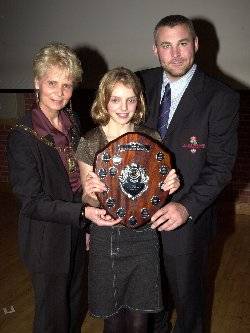 |
Three of the
Clubs athletes have received grants at the London Borough Of Bromley
Excellence Awards 2002 which were held at the Pavilion Leisure
Centre.
The
2002 winner of the prestigious "Sports Scholarship Award" was Rebecca
Taylor. At 13 years old she is a valued athlete at Blackheath
Harriers, Bromley - where this season she has set 3 new club records. Her
800m record is the fastest in the UK this year and her 1000m record is 4th
in the United Kingdom all time rankings. She retained her County Under 13
titles at both cross-country and 800 metres and added to these with
victory in the London Mini Marathon.
|
|
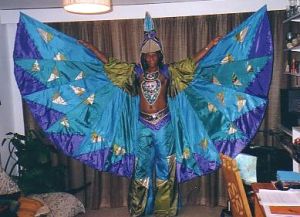 |
It"s Nolan Simmons!
Nolan has been involved in the Notting Hill
Carnival for many years. One day he will bring his assorted
costumes down to the Clubhouse. 2-05-02 |
That our Club holds copies of
ALL
past issues of the Gazette, the Courier and also
Athletic Weekly as well as other Athletic items. If you would like to do
research or want more information please contact the
Archivist,
outlining your requirements. This link
gives you details of Supplements, Newsheets and Couriers.